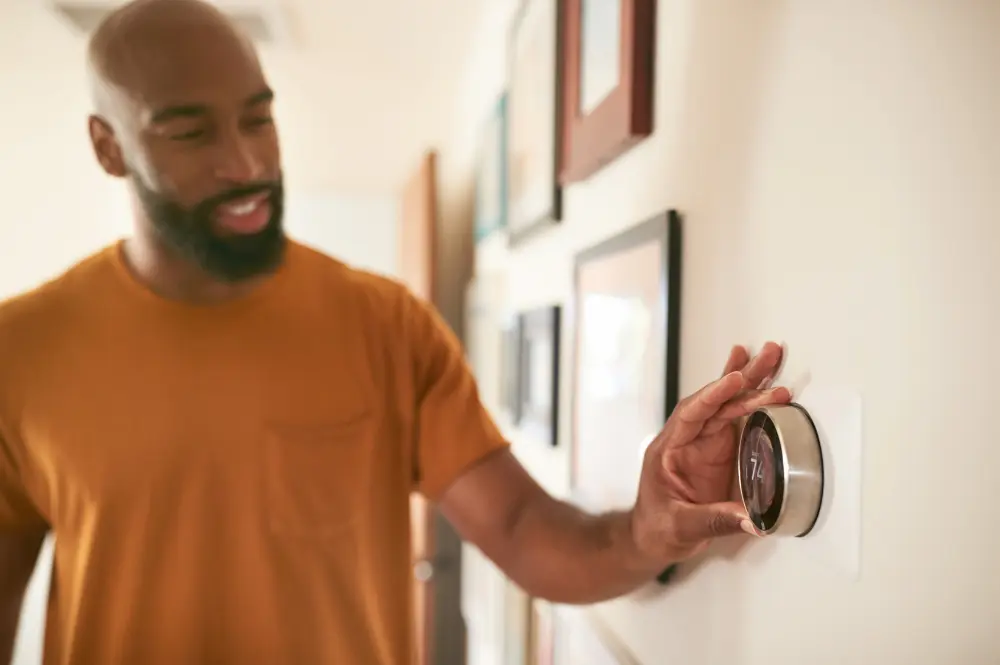
Most homeowners don’t think about the thermostat on the wall until something feels off. The upstairs bedroom runs five degrees warmer than the living room. The heating kicks on at 3 a.m. for no clear reason. Or the bill arrives and it’s noticeably higher than the same month last year.
A thermostat is a small device, but it controls the most expensive system in your house. Swapping an old thermostat for a smart one is one of the least disruptive upgrades you can make, and for a lot of New Jersey and Eastern Pennsylvania homes, it pays for itself faster than people expect. Here’s what smart thermostat installation involves, what it costs, and how to tell whether your home is a good candidate.
Key Takeaways
-
Smart thermostat installation usually costs between $100 and $300 for professional labor, plus $100 to $300 for the device itself.
-
Most installations take one to three hours depending on the complexity of your wiring and HVAC system.
-
Compatibility comes first. A smart thermostat has to match your heating and cooling equipment before anything else matters.
-
A C-wire is often required, and older homes in this region frequently don’t have one.
-
Smart thermostats can learn your schedule, use geofencing to adjust when you leave, and track energy usage over time.
-
Most thermostats last 10 to 15 years, so a new thermostat is a long-term investment in comfort and energy savings.
What Makes Modern Thermostats Different
Programmable thermostats have been around for decades. You set a schedule, and the unit follows it. That works fine until your schedule changes, which for most families is constantly.
Modern thermostats connect to your home Wi-Fi and make decisions on their own. They learn how long your house takes to warm up or cool down and adjust ahead of time instead of reacting after the fact. Geofencing uses your phone’s location to ease back the temperature once you’ve left and start recovering before you pull in the driveway. You get full control from a smartphone or tablet, so changing the setting from the office or from a hotel room takes a few seconds.
Most smart thermostats also track energy usage and show you where your money is going. Many send an alert when a filter needs changing or when runtime spikes unexpectedly. That last feature matters more than the app does. A thermostat telling you your system ran twice as long as usual last week is giving you an early warning worth acting on.
Benefits Homeowners Actually Notice
Lower heating and cooling costs. Heating and air conditioning make up roughly half of a typical home’s energy use. When your system stops conditioning an empty house and recovers temperature gradually instead of blasting to catch up, that adds up across a season.
Fewer temperature complaints. Smart thermostats handle shoulder seasons much better than a manual unit. In April and October, when a Jersey day starts at 42 degrees and ends at 72, that flexibility is worth a lot.
Control from wherever you are. Coming home early, leaving for a long weekend, or checking the house while you’re away all become simple from your phone.
Better humidity control. Summers here are humid. Some models can run your cooling system in a way that pulls more moisture from the air, which makes 75 degrees feel closer to 72.
Usage data you can use. Monthly reports make it much easier to spot a system starting to struggle before it quits in the middle of July.
Smart home integration. If you already use voice assistants or a smart home hub, your thermostat can work alongside everything else instead of sitting off on its own.
Signs It’s Time for a New Thermostat
Not every current thermostat needs to go. If yours holds temperature accurately and you’re happy with it, there’s no urgency. Consider replacing it if you notice any of these:
-
The reading on the wall doesn’t match how the room feels
-
Your system short cycles, turning on and off in quick bursts
-
The display is blank, dim, or flickering
-
It’s a mercury dial or slider, which usually means it’s 20 or more years old
-
The house went cold and the furnace never got the signal
-
You’ve finished a basement, added a room, or changed how you use the house
A failing thermostat can also make a healthy HVAC system look broken. We’ve been called out for plenty of no-heat calls where the fix was the thermostat, not the furnace.
What Smart Thermostat Installation Costs
Two numbers make up your total: the device and the labor.
The thermostat itself generally runs $100 to $300. Entry-level Wi-Fi models sit at the lower end. Units with remote room sensors, larger touchscreens, and humidity control land higher.
Professional thermostat installation typically runs $100 to $300 for a straightforward replacement. That covers cutting power at the breaker, removing the old unit, mounting and wiring the new one, configuring it for your specific equipment, connecting it to WiFi, and testing every mode before we leave.
So most homeowners land somewhere between $200 and $600 all in.
A few situations move the cost up:
Wiring updates. Wiring work is the single biggest variable and can increase installation costs significantly. Smart thermostats need continuous power, delivered through what’s called a C-wire. Plenty of homes in this region were wired before that became standard. Depending on your setup, we either add an adapter at the furnace or run new thermostat wires.
Moving the thermostat to a new location. If the current spot sits in direct sun, above a radiator, or on an exterior wall, relocating it gives you far more accurate readings. It also means running new lines and patching the wall, which adds labor.
Heat pumps with auxiliary heat. These need precise configuration. Set up wrong, the thermostat calls for electric backup heat when it doesn’t need to, and your January bill will tell you about it.
Boilers and radiant heat. Hydronic systems, zone valves, and millivolt controls each have their own requirements. Not every smart thermostat is compatible, and picking the wrong one is a common and frustrating mistake.
Multiple zones. Each zone needs its own thermostat and its own setup at the control panel.
Line voltage systems. Electric baseboard heating runs on high voltage and requires a completely different category of device.
Also worth a look before you shop: your utility may offer a rebate or bill credit for a qualifying smart thermostat. That can cut what you pay out of pocket.
Can You Install a Smart Thermostat Yourself?
Sometimes, yes. Installing a smart thermostat is a reasonable DIY project when your HVAC system is compatible, a C-wire is already present, and the existing wires are clearly labeled. Plan on an hour or so if everything goes smoothly.
You’ll want a screwdriver, a level, your phone for the app and for photos, and possibly a drill to make new holes for the mounting plate.
Here’s the general process:
-
Cut the power. Turn off your HVAC system at the breaker panel, not just at the thermostat. Confirm the blower won’t start before you touch anything.
-
Photograph the wiring. Pull the faceplate off the old thermostat and take a clear picture of the existing wires and terminals. This is the step people skip and then regret.
-
Label the wires. Use the stickers included with the new thermostat, or tape and a pen. Label them before you disconnect anything.
-
Keep the wires from falling into the wall. Wrap them around a pencil or clip them so they can’t slip back through the opening. Fishing thermostat wires out of a wall cavity turns a one-hour job into an afternoon.
-
Mount the new backplate. Use it to mark and drill holes, check it with a level so it sits straight, and secure it with the included screws. A trim plate covers scuffs or old holes left behind by the previous unit.
-
Reconnect the wires to their matching terminals using your photo and labels as a reference.
-
Restore power and run setup. Attach the faceplate, turn the breaker back on, and walk through the on-screen setup. Connect to WiFi so you get remote access.
-
Test every function. Call for heat, then cooling, then fan only. Confirm each one starts and stops the way it should.
The trouble usually shows up in one of three places. There’s no common wire. The old labels don’t match what the new device expects. Or you’re on a heat pump and the setup menu asks configuration questions you have no confident way to answer.
The risk isn’t just a lost afternoon. Miswiring a thermostat can take out the low-voltage transformer or the control board on your furnace or air handler, and those repairs cost far more than the installation would have. If you open the wall plate and see something you don’t recognize, or if you’re unsure about a terminal, stop there. That’s the right call, and there’s no shame in it.
How Binsky Handles Smart Thermostat Installation
Our technicians follow the same process on every job, from a simple swap to a tricky boiler setup.
-
We confirm compatibility first. Before anything comes off the wall, we identify your heating and cooling equipment and verify the thermostat you want will control it properly.
-
We check the wiring. If a C-wire is needed or the existing lines are in rough shape, you hear what it takes and what it costs before we begin.
-
We install to code. Mounting, wiring, and any related electrical work is done in line with local codes. If a job calls for a licensed electrician, we have one.
-
We configure and connect. Equipment settings, WiFi setup, schedules, and geofencing if you want it.
-
We test everything. Heating, cooling, fan, and any staging or auxiliary heat, verified in front of you.
-
We walk you through it. Ten minutes with the app and the settings that matter saves a lot of guessing later.
-
We note anything else we see. If your system shows signs of wear, you get an honest heads-up with no pressure attached.
We work in homes across New Jersey and Eastern Pennsylvania every day, so we know how these houses are wired. A job that stumps a general handyman is usually routine for us. Our technicians arrive on time, respect your home, and clean up the site before they go.
Making Your Thermostat Last
Most thermostats last 10 to 15 years with reasonable care. A few habits stretch that out:
-
Replace the batteries when the low-battery warning appears rather than waiting for the screen to go dark
-
Keep the vents on the unit free of dust
-
Have wiring integrity checked during seasonal HVAC tune-ups
-
Give a new thermostat two or three weeks to learn your patterns before judging the savings
-
Set a realistic schedule instead of a perfect one, because a thermostat you constantly override isn’t helping
-
Turn on filter reminders and actually act on them, since a clogged filter cancels out a lot of efficiency gains
One honest note about smart models: because they rely on software and app support, they can feel dated sooner than a basic unit even while the hardware still works fine. That’s the tradeoff for the features.
Ready to Upgrade Your Thermostat?
A smart thermostat is a small project with a long payoff, and it goes a lot smoother when someone who knows your kind of heating system handles the wiring and setup. Binsky Home Service installs, replaces, and configures thermostats for homeowners throughout New Jersey and Eastern Pennsylvania, and you’ll get a straight answer about what your system supports before you spend a dollar on equipment.
Need a thermostat replacement, a new install, or a second opinion on a system that won’t hold temperature? Binsky’s your guy.
Schedule Service to request an estimate today.
Frequently Asked Questions
How long does smart thermostat installation take?
Most jobs take one to three hours. A straight replacement on compatible wiring is on the short end. Adding a C-wire, relocating the unit, or setting up multiple zones takes longer.
Will a smart thermostat work with my older furnace?
Usually, yes. Most conventional gas furnaces and air conditioning systems work with smart thermostats as long as power can be supplied to the device. Very old millivolt setups and electric baseboard heat are the main exceptions, and there are alternative options for both.
Do I need an electrician or an HVAC technician?
For a standard thermostat replacement, an HVAC technician handles it. If new circuits or panel work are involved, a licensed electrician gets pulled in. Binsky does both, so you’re not chasing two companies.
How much will I really save?
It depends on how you ran things before. Households that held one temperature around the clock tend to see the biggest drop. Homes already using a well-tuned schedule see smaller savings and more of a comfort and convenience gain.
Do I need a separate thermostat for every zone?
Yes. Each zone operates independently and needs its own control.
Should I replace my thermostat when I replace my HVAC system?
It’s the ideal time. New equipment often has staging or variable speed capability an old thermostat can’t use, so you’d be paying for efficiency you never get.
I searched for smart thermostat installation near me and got a dozen results. What should I look for?
Ask whether the company verifies compatibility with your specific system before recommending a model, whether they handle wiring updates like adding a C-wire, and whether they test every mode before leaving. Those three answers separate a real installation from a faceplate swap.