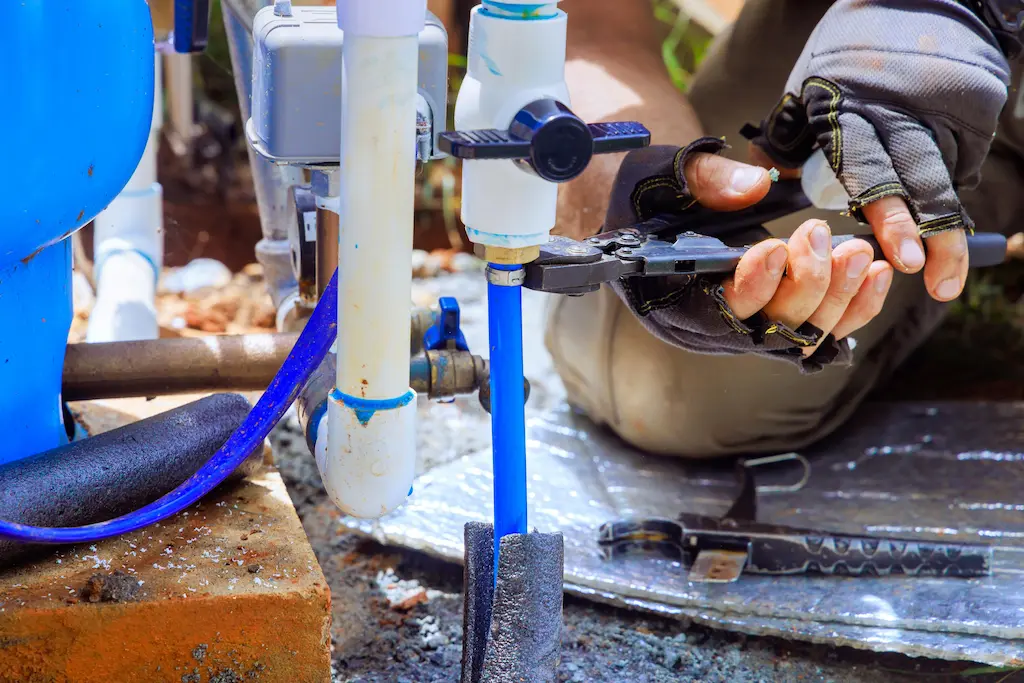
A water main gets extended down your street. A neighbor mentions their water bills. Your pressure tank starts short cycling again, or the water softener needs another repair, and you find yourself wondering what it would actually take to tie into the public water supply instead.
That question comes up a lot in the towns we serve, and the honest answer is that it depends less on your plumbing than on your municipality. Running a new water main line into a house is routine work for a licensed plumber. The permits, fees, and rules around your existing well are where homeowners get tripped up. Here is how the whole process fits together, in plain language.
Key Takeaways
-
You can only connect if a city water main runs adjacent to your property. The utility confirms this, not your plumber.
-
Most municipalities charge tap and connection fees on a new service application, separate from the plumbing and excavation work itself.
-
The utility or its approved contractor usually taps the main and sets the water meter. Your plumber handles the line from the curb stop into the house.
-
Plumbing and excavation permits come first, and municipal inspection closes the job out.
-
In New Jersey, an unused private well must be sealed by a licensed well driller under NJDEP rules. It is not a DIY project.
-
You can sometimes keep the well for an irrigation system, hose bibbs, or filling a pool, but only with complete separation from the potable water system and utility approval.
-
Some towns require you to connect once public water is available at the property line, so check the local ordinance before planning around it.
First: Is City Water Even Available at Your Property?
This is step one, and it saves people a lot of wasted planning. A main has to already exist within reach of your lot. Call your local water utility or municipal water department and ask two things: whether a main fronts your property, and what the current connection fee is.
If the main stops three houses short of yours, you are looking at a service line extension, which is a much bigger project involving the utility, engineering review, and sometimes a cost-sharing arrangement with neighbors. Worth knowing early, because that long run changes the cost picture completely.
While you have them on the phone, ask whether your town has a mandatory connection ordinance. A number of New Jersey and Pennsylvania municipalities require homes to connect to public water once service reaches the property line, particularly after a main extension project. That changes the conversation quickly.
Well Water vs. City Water: An Honest Comparison
Plenty of homeowners are happy on a well, and we are not going to pretend otherwise.
Your own well gives you independence from the utility, no monthly water bill, and unmetered water for irrigation and the pool. The tradeoff is that you are the water system operator. Annual testing for potential contaminants is on you. So is the well pump, the pressure tank, the electricity to run it, and the treatment equipment that keeps iron staining and hardness in check.
Municipal water is the low-maintenance side of the trade. It is treated, disinfected, and tested by the supplier under federal Safe Drinking Water Act standards that the EPA sets and state agencies enforce, so water quality is monitored continuously without any effort from you. In exchange, you get a metered bill every month and you accept whatever the local rate structure looks like.
Neither answer is universally right. What usually tips the decision is a failing pump, a well with a water quality problem that treatment cannot economically fix, or an ordinance that makes the choice for you.
How to Get City Water Instead of Well: The Step by Step Process
Every town words it a little differently, but the sequence is remarkably consistent.
1. Application and permits. You or your plumber files a service application with the water utility, plus plumbing and excavation permits with the local construction office. The utility issues tap authorization and specifies your service size, usually 3/4 inch or 1 inch for a single-family house, along with approved pipe material.
2. Fees get paid. Tap fees, connection fees, meter fees, and inspection fees are handled up front. These are set by the municipality or authority and are often the single largest line item in the project.
3. The main is tapped. In most service areas, the utility or an approved contractor performs the water main connection to house, installs the corporation stop, and sets the curb box and shutoff in the right-of-way. Some authorities allow a licensed plumber to do the tap under inspection. Either way, this part follows the utility’s rules exactly.
4. Trenching to the house. This is the visible part of the job. A trench runs from the curb stop to your foundation, deep enough to stay below the frost line, which in our region generally means four feet or more of cover. Copper or approved PE tubing goes in, bedded in clean soil, with a tracer wire where required. Where a driveway, concrete walkway, mature trees, or hardscaping sit in the path, directional boring often makes more sense than open trenching even though it costs more.
5. Meter set and entry into the home. The line enters through the foundation and gets sleeved and sealed. Water meters are typically installed either in an outdoor pit near the curb or inside the house in a utility area, basement, or mechanical room, depending on what your supplier requires. A main shutoff and any required backflow device go in with it. Your interior pipes are then tied into the new service.
6. Inspection, pressure test, and disinfection. The town inspects the installation, the line is pressure tested, and the utility flushes and activates service.
7. Well disconnection and decommissioning. The well pump, pressure tank, and any treatment equipment come off the potable system. Then the well itself has to be dealt with, which deserves its own section.
Start to finish, expect several weeks of calendar time even though the fieldwork often takes only a day or two. Permit review and utility scheduling drive the timeline, not the digging.
What Happens to the Old Well?
This is the part homeowners ask about most, and the rules are stricter than people expect.
In New Jersey, a well taken out of service has to be properly sealed and decommissioned by a licensed New Jersey well driller under NJDEP regulations, with the abandonment reported to the state. An open or improperly capped hole is a direct pathway for surface runoff and chemicals to reach groundwater, which is exactly why the state regulates it. Your plumber disconnects the well from the house. A licensed driller seals the well.
In Eastern Pennsylvania, statewide requirements for private well abandonment are looser, but many townships and county health or conservation offices set their own standards, and good practice is the same: grout and seal the borehole, remove or cut the casing to the specified depth, and document the work. No state rule does not mean no local requirement. Ask the township before you assume.
Can You Keep the Well for Irrigation and Outdoor Use?
Often yes, and it is a genuinely appealing option. An irrigation system, hose bibbs, filling a pool, and washing the car on unmetered water can save money over a summer, especially on a larger property.
The condition is absolute physical separation. The well system and the city supply cannot be interconnected anywhere, not even through a valve you promise to keep closed. A cross-connection can push untreated water back into the public main, and utilities treat that as a serious violation. Practically, that means:
-
Dedicated piping for the well-fed outdoor lines, sharing nothing with indoor plumbing
-
Clearly labeled fixtures identifying non-potable water
-
A reduced pressure zone assembly or other approved backflow protection where required
-
Utility notification and inspection, and in some service areas annual backflow testing
Some municipalities simply prohibit keeping an active well once you are on public water. Others allow it with a permit and a filed cross-connection survey. Confirm the policy before you spend money engineering around it, because the answer varies by authority rather than by state.
What Changes Inside Your House After the Switch
A few things worth planning for.
Pressure. City supply usually delivers steadier and higher pressure than a pump and pressure tank did. That is normally welcome, though when incoming static pressure runs above roughly 70 to 80 psi, a pressure-reducing valve protects your fixtures, water heater, and appliance supply hoses. It is a small addition that prevents a lot of nuisance leaks and premature repairs.
Treatment equipment. Your softener, iron filter, and sediment cartridges were sized for your well chemistry. Municipal water is already treated, so the hardness and iron staining you have been fighting typically disappear along with the media, salt, and chemicals you have been buying. Many homeowners still like a point-of-use or whole-house water filtration system for taste and chlorine reduction in their drinking water, which is a preference rather than a necessity. We are happy to test the new supply and tell you honestly what is worth keeping.
Your water heater. Softened well water and municipal water behave differently inside a tank. If your heater is already near the end of its life, the changeover is a natural moment to look at replacement rather than doing the work twice.
Monthly cost. You are trading pump electricity, treatment media, annual testing, and eventual pump replacement for a metered utility bill. Depending on household size and your local rate per gallon, that math lands differently for different homes.
Leak detection gets easier. One quiet benefit of a water meter: shut off every fixture, watch the dial, and any movement means water is going somewhere it should not. On a well, a slow leak just looks like a pump that runs a little more often. If you see that dial creeping, call us before it finds your ceiling.
One Common Point of Confusion: Water and Sewer Are Separate
Connecting to city water does not put you on public sewer. Those are two different utilities, two different permits, and two different sets of fees. Plenty of homes in our service area run municipal water with a septic system and function perfectly well that way. If both are available on your street and you are considering both, it is often cheaper to coordinate the excavation once instead of opening the same yard twice.
Why Homeowners Call Binsky
We have been working in New Jersey homes for a long time, and a well to city water conversion touches nearly everything we do: service line installation, trenching and restoration, meter and backflow setup, pressure regulation, removing the old pump and tank, evaluating your water heater and filtration, and coordinating the inspections that make it all official.
The real value is in sequencing. We know which utilities require their own contractor for the tap, which towns want the meter in a specific location, what documentation the inspector will ask for, and when to bring in a licensed driller so your project does not stall waiting on a permit nobody filed. When a job has this many moving parts and this many phone calls, Binsky’s your guy.
Ready to Talk Through Your Options?
If you are weighing a switch from well water to city water, the fastest way to get real answers is a conversation with someone who has done the work in your town. We will look at your property, walk the likely service route, explain what your utility requires, and put together a clear estimate with no pressure attached.
Schedule Service with Binsky Home Service, or call to request an estimate for your water service connection.
Frequently Asked Questions
How do I get city water instead of well water?
Confirm with your local water utility that a main serves your street, file a service application along with plumbing and excavation permits, pay the tap and connection fees, have the main tapped and a service line trenched to the house, set the water meter, pass municipal inspection, then disconnect and properly decommission the well. Licensed professionals are required for most of this work, and a plumber typically manages the house-side installation and permit coordination.
How much does it cost to convert well water to city water?
Costs swing widely because the two biggest variables sit outside the plumbing itself: your municipality’s connection and tap fees, and the distance from the main to your house. A long run, a driveway, rock, or boring all add to it. Ask your utility for the current fee schedule first, then get a scoped plumbing estimate so you are comparing complete numbers rather than partial ones.
How long does a city water hookup take?
The excavation and installation usually take one to a few days. The full project generally runs several weeks once you account for permit review, utility scheduling, inspection, and well decommissioning.
Do I have to abandon my private well?
If you are taking it out of service in New Jersey, it must be sealed by a licensed well driller under NJDEP rules. If you want to keep it for an irrigation system and outdoor spigots, that is sometimes permitted with complete disconnection from indoor plumbing, backflow protection, and utility approval.
Is city water better quality than well water?
Municipal suppliers test and treat continuously under federal drinking water standards, so quality is monitored for you. A well can produce excellent water, but you are responsible for annual testing and for treating whatever the groundwater brings, including iron, hardness, bacteria, and other potential contaminants.
Will my water pressure change?
Usually yes, and typically for the better. When incoming pressure runs high, we install a pressure-reducing valve to protect your fixtures, appliances, and water heater.
Can I keep my water softener?
You can, though most homeowners on municipal water no longer need one. We will test your new supply and give you a straight answer about what to keep and what can come out.